
Cloud Security Assessment — know exactly where your cloud stands.
Purple Shield reviews how your AWS, Azure, Google Cloud and Microsoft 365 environments are configured, accessed and governed against the standards buyers and auditors trust: the CIS Benchmarks, the NIST Cybersecurity Framework, and the Well-Architected security pillar then hand you a ranked roadmap. From there we secure and monitor: hardening, IAM & least privilege, data protection and detection.
Independent
Vendor neutral
No products to sell
CREDENTIALS BEHIND THE ADVICE
CISSP
CISM
CRISC
AAISM
Cloud Security Assessment, Explained
What is a cloud security assessment?
A cloud security assessment is a structured review of how your cloud environments are configured, secured and governed, measured against recognized standards — so you know precisely where you're exposed, what to fix first, and what you can prove to buyers and auditors.
Assess how your cloud is configured
Your business runs on AWS, Azure, Google Cloud, and Microsoft 365. A single misconfiguration can expose everything. We inventory your accounts, benchmark every configuration against the CIS Benchmarks and NIST CSF, and surface the public buckets, open ports and weak encryption before an attacker does.
Assess who can reach it
Over-permissioned identities and standing access are how a small mistake becomes a full breach. We map your IAM against least-privilege principles and the Well-Architected security pillar, human and machine identities, roles, keys and third-party access and show you exactly where to tighten it.
Why benchmarks? Because "we're on the cloud, so we're secure" isn't true, and the shared responsibility model puts your configuration, access and data on you. Mapping your environments to the CIS Benchmarks, the NIST Cybersecurity Framework and the Well-Architected security pillar turns a vague worry into a measured score, a ranked roadmap, and evidence you can put in front of an enterprise buyer or an auditor.
Three Standards, One Assessment
The standards we assess you against.
Each standard answers a different question about your cloud. Together they give you a complete, defensible picture from boardroom governance down to the exact setting an attacker would exploit.
01
Configuration hardening · the misconfiguration baseline
The consensus-driven, per-cloud hardening baselines for AWS, Azure and GCP. We benchmark your live configuration against them, control by control, and rate each gap by exposure.
-
Per-cloud baselines — AWS, Azure & Google Cloud
-
Storage, network & encryption settings
-
Logging, monitoring & account hygiene
-
Pass / fail scoring against each control
02
Governance & controls · the regulator baseline
The framework U.S. regulators and enterprise buyers point to. We assess your cloud program across its core functions and map controls to NIST 800-53 and CSF for depth and evidence.
-
NIST 800-53 and CFS control coverage & mapping
-
Maturity score per function
-
Evidence buyers and auditors accept
03
Secure architecture · the design standard
The security pillar of the AWS, Azure and GCP Well-Architected frameworks. We review how your cloud is designed — identity, data protection, detection and incident response by design.
-
Identity & access foundations
-
Data protection in transit & at rest
-
Detection, logging & response design
-
Infrastructure & workload protection
What You Walk Away With
An assessment you can act on and show.
No 80-page PDF that sits in a drawer. You get a clear picture of where you stand, what to do next, and the evidence to put in front of the people who ask.

Posture scorecards
A maturity score against CIS Benchmarks, NIST CSF and the Well-Architected security pillar at a glance.

Identity inventory
Your accounts, identities, workloads and the data behind them, shadow SaaS and forgotten resources included.

Misconfiguration findings
Every configuration and access gap that matters, each rated by likelihood and business impact.

Ranked roadmap
A prioritized fix list — what to remediate first, what it protects, and the effort it takes.
Why Assess Now
The cloud moves fast. Misconfiguration moves faster.
Your cloud footprint grows every week, new accounts, new services, new access. Without measuring it against a real standard, the exposure stays invisible until data leaks, a customer asks how you secure it, or an auditor comes knocking. An assessment puts hard numbers on it first.
Misconfiguration you can't see
Public storage buckets, open security groups and disabled logging are the leading cause of cloud breaches and they hide in plain sight across sprawling accounts.
Data exposed
Sensitive data sits in the cloud over shared, under encrypted, or replicated into places no one remembers. A breach and a compliance finding waiting to happen.
Over permissioned identities
Standing admin access, unused keys and broad roles turn one phished credential into a full-environment compromise. Least privilege is rarely where teams think it is.
Blind to attacks in progress
Without proper logging and detection, cloud intrusions go unnoticed for weeks. You can't respond to what you can't see.
Shadow SaaS & sprawl
Teams spin up SaaS apps and cloud resources faster than anyone can track. Ungoverned, unmonitored, and touching your data with no oversight.
Buyers & auditors demand proof
Enterprise customers now ask how you secure your cloud in security questionnaires and SOC 2 reviews. A weak answer stalls the deal.
Full Cloud Security Services
From knowing where you stand to keeping it locked down.
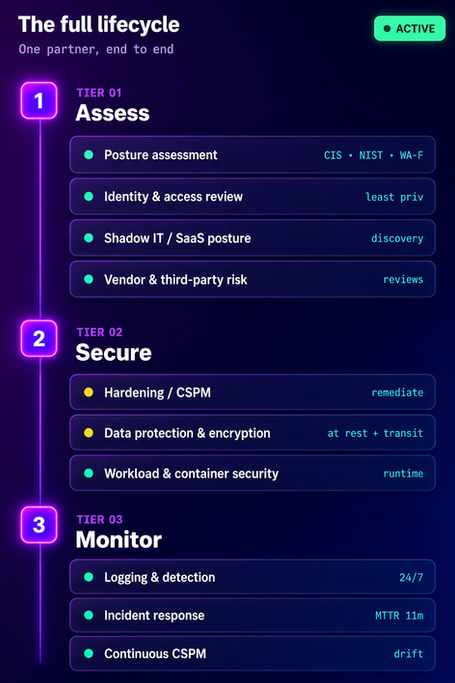
The assessment is the front door. Past it sits a full set of cloud security services, split into two tracks: the work that uncovers your exposure, and the work that secures and monitors against it.
Cloud Security Posture
Your AWS, Azure, GCP and M365 environments scored against all three standards, with a maturity rating and a ranked roadmap of the gaps that matter most.
Identity & Access Review
We map every human and machine identity to least-privilege principles, roles, keys, standing access and third-party grants, and show you exactly what to tighten.
SaaS Posture / Shadow IT
We surface the SaaS apps and cloud resources your teams already run, map the data flowing into each, and turn invisible, ungoverned sprawl into an inventory you control.
Third-Party Risk
Independent reviews of the cloud providers and integrations in your stack, data handling, access and contracts so a supplier's cloud isn't your blind spot.
Cloud Hardening
We remediate the misconfigurations the assessment finds and harden your environments to CIS baselines and ongoing CSPM, so a single setting doesn't become a breach.
Data Protection
Encryption in transit and at rest, key management, sensitive-data classification and access rules, keeping customer data and IP protected wherever it lives.
Workload Security
Hardening for the compute you run — VMs, serverless, containers and Kubernetes — with image scanning, runtime protection and secure-by-default configuration.
Detection & Response
Centralized logging, cloud threat detection and a clear incident-response plan — so intrusions are seen early and handled fast.
The Difference It Makes
Guessing about cloud risk vs. measuring it.
Unassessed cloud vs. a Purple Shield cloud security assessment
Cloud with no assessment
Visibility
No idea which accounts, identities or data are exposed.
Benchmark
A vague sense that the cloud is "probably fine"
Misconfiguration
Public buckets and open access found by attackers first
Access
Broad, standing admin access nobody has reviewed
Independence
Guided by whichever vendor sells the loudest
Purple Shield Assessment
Visibility
A scored inventory of cloud accounts, access and data
Benchmark
Maturity scores vs. CIS, NIST CSF & Well-Architected
Misconfiguration
Every gap surfaced, rated and remediated to CIS baselines
Access
IAM mapped and tightened to least privilege
Independence
Vendor-neutral — nothing to sell you
How It Works
How the Cloud security assessment works.
Scope
A short kickoff to map your cloud footprint which providers, accounts and workloads you run, and which standards matter to your buyers and auditors.
Assess
We benchmark your configuration against CIS, map your program to NIST CSF, and review your architecture against the Well-Architected security pillar.
Report
You get posture scorecards, misconfiguration findings, and a risk-ranked roadmap in plain language, walked through with your team.
Remediate
Optional hands-on support to remediate, harden and set up detection — so the score, and the evidence behind it, keeps improving.
Credentials That Back The Advice
Decades of hands-on security leadership
Most security advice comes with a sales agenda. Ours doesn't. That single difference changes everything about the guidance you get.

What Our Clients Say
Trusted by firms who can't afford to get this wrong.
Cameron Eghbali - U.S. Games Dist.
"As a mid-size company, we didn’t have the resources for a full-time CISO. Purple Shield’s vCISO gave us top-tier leadership and a clear roadmap to strengthen our security while scaling our business."
Brian Cohen - Q&A Manufacturing
"We don’t have the budget for a full-time CISO, so having Purple Shield as our vCISO has been a lifesaver. They translated all the security jargon into plain English and gave us a clear plan we could actually follow. I finally feel like we know where we stand and what to do next."
Joe Mobassernia - Mobassernia, P.C.
We were scaling faster than we could keep up with, constantly adding people and systems, and security was the thing nobody owned. We needed someone to just take it off our plate and keep us safe while we grew. Purple Shield stepped in and ran the whole program, set up the right controls, and grew the security side right alongside us.
Our Numbers
Two decades of results behind every engagement.
200+
Clients Served
30+
Incidents Responded To
20+
Years of Experience
100+
Assessments Completed
Senior security leadership, on demand.
Let's talk about where your business stands today. We'll talk through where your firm is exposed and the first steps that matter most — in plain English, with no sales agenda.