
BlueKit Phishing Kit: What This New AI-Powered Threat Means for Business Security
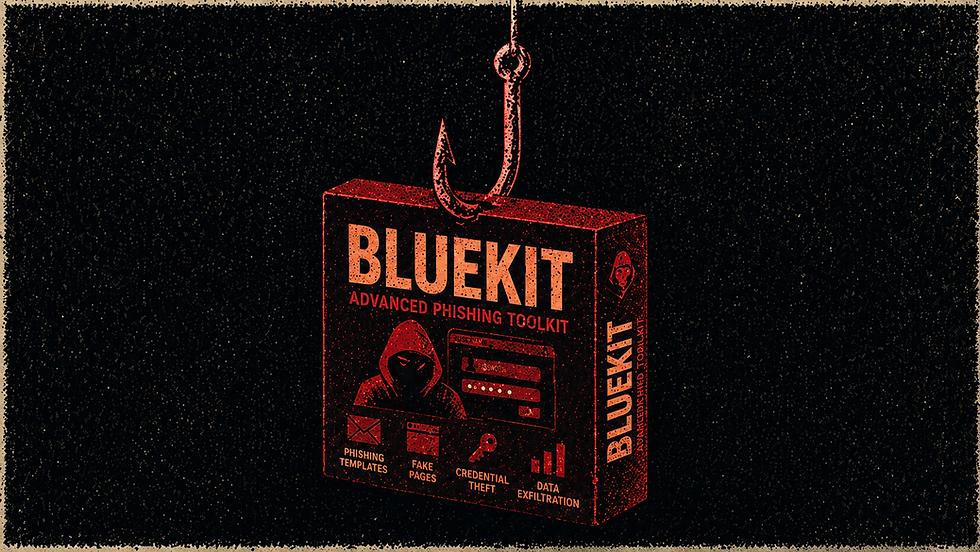
Phishing didn’t disappear when companies added multi-factor authentication. It just got smarter. A new phishing-as-a-service platform called BlueKit shows exactly how quickly the threat is evolving.
Varonis Threat Labs recently examined BlueKit and found a single dashboard that handles everything an attacker needs: domain registration, realistic login pages, campaign delivery, and real-time data exfiltration. It’s designed for speed and scale, not just technical experts. That shift changes the risk calculation for every organization that relies on email, cloud accounts, or remote access.
What Is BlueKit
BlueKit is a commercial phishing kit sold as a service. Instead of piecing together tools from different underground sellers, operators get one panel that manages the entire attack lifecycle.
It ships with more than 40 ready-made templates mimicking widely used services—iCloud, Apple ID, Gmail, Outlook, GitHub, and even retail or crypto platforms. The pages look legitimate, load quickly, and support behaviors that bypass common security checks.
What makes this kit different is how it packages advanced features that used to require custom development or multiple vendors. Automated domain buying, geolocation spoofing, device fingerprint filtering, and Telegram-based data delivery all sit inside the same interface. Updates roll out frequently, which means the service keeps adapting.
How the Kit Lowers the Bar for Sophisticated Attacks
AI Assistant in Action
BlueKit includes a built-in AI assistant with access to several large language models, including an “abliterated” version of Llama that has safety filters removed. Operators can ask it to draft phishing emails or campaign outlines. The output is still basic—mostly structure and placeholders—but it removes the language barrier and speeds up the process for non-native English speakers or less experienced attackers.
Built-in Evasion and Session Hijacking
The real danger sits in the post-login phase. BlueKit uses adversary-in-the-middle techniques to capture not only credentials but also cookies, local storage, and active sessions. It can maintain a live view of the victim’s browser after they log in. That means even if a user completes an MFA prompt, the attacker can hijack the authenticated session. Antibot measures, proxy support, headless browser detection, and redirect rules are all configurable per campaign. The result: attacks that look normal to security tools and users alike.
The Real Business Impact of These Attacks
A successful BlueKit-style campaign rarely stops at one stolen password. It often leads to business email compromise, ransomware deployment, or lateral movement inside the network. For an executive or operations leader, that translates into:
Days or weeks of system downtime while incident response teams investigate
Regulatory notifications and potential fines if customer or employee data is involved
Loss of trust from partners or clients who learn their information was exposed
Direct financial losses from fraudulent wire transfers or unauthorized purchases
Practical Defenses That Actually Work
You don’t need to chase every new threat with another tool. Focus on the fundamentals that directly address how kits like BlueKit operate:
Treat every unexpected login prompt or MFA request as suspicious—especially those involving “account verification” or “security update.”
Enforce phishing-resistant authentication methods such as hardware security keys or passkeys where possible.
Limit session persistence and monitor for unusual login locations or device fingerprints.
Run regular simulated phishing exercises that match current tactics, not generic templates.
Maintain clear incident response playbooks that include immediate account isolation and session revocation steps.
These measures don’t require a massive security team. They require consistent execution guided by someone who understands both the technical details and your business priorities.
How Purple Shield Security Helps Organizations Stay Ahead
Cybersecurity is no longer a checkbox for compliance audits. It’s an operational risk that sits alongside supply-chain issues, talent retention, and cash flow. When attackers can rent a professional-grade phishing platform for the price of a few monthly subscriptions, the probability of an incident rises sharply.
Business owners and executives who treat security as a shared responsibility—rather than an IT silo—catch problems earlier and recover faster. A fractional CISO or vCISO can translate these evolving threats into concrete policies, training, and technology decisions that fit your actual operations.
At Purple Shield Security, we work with companies and organizations across the U.S. that need practical cybersecurity leadership without the overhead of a full-time C-suite hire. Our vCISO services, fractional CISO engagements, and compliance-as-a-service programs are built for executives who want clear risk reduction, not slide decks.
Ready to move from reactive to proactive? Contact Purple Shield Security for a focused cybersecurity assessment tailored to your operations. We’ll review your current controls against real threats like BlueKit and give you a prioritized roadmap that leadership can act on immediately.


